
Altyn Emel national
park
Altyn Emel National Park is one of my favorite places in the Almaty region! I love it for endless steppes, mysterious dark old mountains and feeling that it never changes – someone three hundred years ago could stay at the same place and see completely the same fantastic landscape! So let me show you what you will see at one of the largest national parks in Kazakhstan covering an area of about 4600 square kilometers. Hopefully, we will have a chance to show you this park on our 2-day tour.
Its southern boundary is formed by the Ile River and by Lake Kapchagai. The northern boundary of the park is marked by a line of hills, a western spur of the Dzhungar Alatau range, whose name changes from west to east: Degeres, then Altyn Emel, then Koyandytau. It is said that the name ‘Altyn Emel’, which means ‘golden saddle’, was given to the hills by Genghis Khan when he passed this way in 1219 and saw them covered with sun- yellowed grass. I guess it happened after the rain, when the sun suddenly goes out of heavy black clouds and all grass scorched by merciless steppe heat starts to shine like liquid gold against a background of a black cloudy sky and accompanied by a surrealistic rainbow (sometimes even two!). I wish all my guests would see it with their own eyes! In the east of the park are two further ranges, Katutau and Aktau. The rest of the park comprises a dry plain.
The way from Almaty to the main village Basshy takes around three hours. There is a great highway till Saryozek, Saryozek the road is ok, with some potholes. On the way, we will pass Kapchagay – a city in the Almaty region that appeared due to the start of construction of the Kapchagai hydroelectric station. It’s famous now for casinos and giant artificial lake built in Soviet times. It’s forbidden to gamble in Almaty and all playful dudes can satisfy gambling hunger in this little town not far from Almaty. However for most of locals, Kapchagay is more familiar for cheap “sea and beach” experience just one hour away from home – reservoir was built in the 1970s, it stretches for around 100 km from East to West, the maximum depth is 45 metres, but mostly it’s shallow so you need to walk a bit if you want to swim. At the site of the reservoir was the village of Ili. Due to flooding, residents were resettled in the villages of Novoilisk and Zhetygen and the newly formed collective farm Arna.
After Kapchagay we will pass Saryozek village and few other tiny villages, the landscape will be enriched by the Altyn Emel mountains range. On the final stage of the way, we will drive through again Altyn Emel mountains pass and enter the territory of the national park.
Accomodation in Altyn Emel National Park.
So after arrival at AENP, the first thing we need to do is to visit the central office of the park in Basshy village in order to pay entry fees. The positive part of that event is a nice little museum where you can discover the history, flora, and fauna of the park. There is a lunch break from 1 to 2 pm when the office is closed. You won’t be allowed to visit other parts without the paper permission you receive in this office.
Most of all visitors of NP stay also in the same Basshy village. There are few options: Aigay Kum hotel, another hotel managed by NP staff, and homestay at Zhanka’s home. Aigay Kum is the most popular choice because of the great level of comfort – impeccably clean twin rooms with shower and toilet inside of the room. But in terms of food, it’s always better to choose a less comfortable homestay – no logical reason, but the food is just tastier!
Also, we can do camping on these four points:
Shygan, near Basshi – nice flat area, it’s possible to camp or to stay at the house of the ranger Serik, our grrreat friend. This option will be best for those guests who are interested to see Jeirans – antelopes living in these steppes. Early in the morning (5-6 am) they cross the valley to drink water at the Ili River.
Mynbulak (near the Singing sand dune – the second pin, rangers’ farm. This option will be great for those guests who are interested to stay long at Singing Dune to enjoy a beautiful sunset and maybe to do impressive photos. Mynbulak is located closest to the Dune compared to all other points, so we won’t have problems driving back in the darkness, which is forbidden by the rules of the park. Only camping is available at Mynbulak point.
Kosbastau, or the 700-year-old willow tree – our less visited point in whole AENP cause of crazy mosquitoes living here.
Aktau mountains – this is the best option for those who want to dive into the magical world of Aktau, standard three hours are never enough for this place! And of course unforgettable sunset and sunrise are the bonus for choosing to camp here.
Day 1st: Singing Dunes
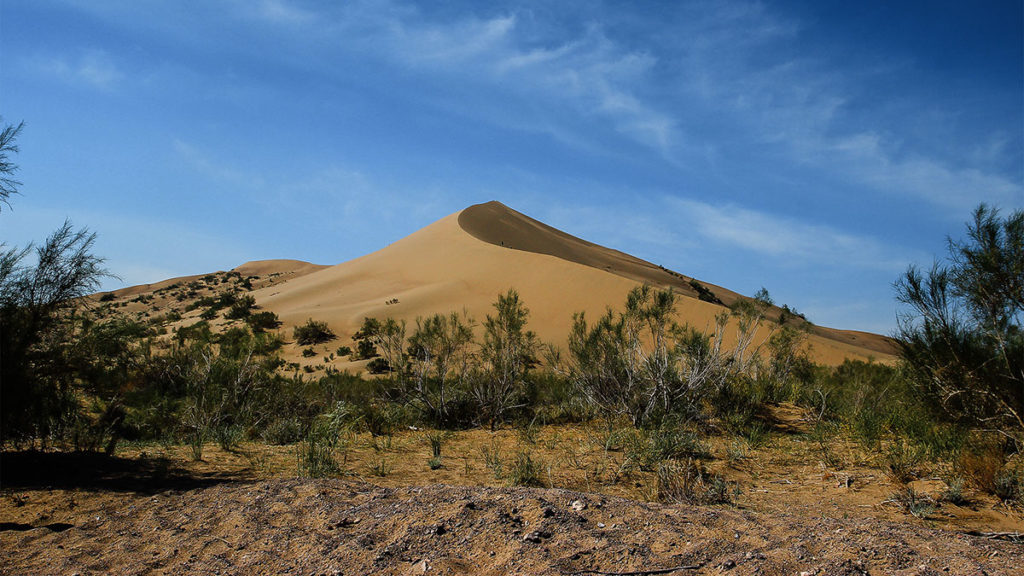
Singing sand dune is a miracle of nature, rising for 150 meters incongruously above the steppes between the Kalkan mountains. The Small and Big Kalkans are the Paleozoic range of the exposed type characterized by the intense destruction of the rocks. The mountains are not high and not very remarkable. They are located in the southern part of the National park and there is nothing special about them. But between those mountains there is the worldwide famous Singing Barkhan, also called the Singing Sand Dune, the pearl of Altyn-Emel. The structure famed for the sound it produces low-pitched, organ-like rumble in dry weather. Physicists explain this mystery by the friction of dry grains of sand and crystalline electrization. Geologists have been losing in conjectures for many years on the unnatural origin of the sand dune for such an atypically rocky steppe area. Unlike other sand dunes, this one never changes its shape because here, in the hollow between the hills, the wind rose has a special direction. The ridge of the unique sand dune is sharp as a blade.
For those who never ever climbed the sand dune, it will be really unforgettable experience of going up on the narrow ridge of the dune. I should say it’s not easy especially on a hot summer day but the view you get from the top justifies the long way up. In the south – a thin strip of the Ili River is visible as well as purple mountains of Sogety and Boguty, looking out from the white peaks of the Ketmen ridge. On the west, the horizon is obstructed by the steep slope of the Big Kalkan, and the Small Kalkan – from the east. In the north – a violet-blue ridge of Djungarian Alatau mountains, Chulak mountain, Matai, and Altyn-Emel are visible.
Just don’t forget the hat, SPF cream, and closed shoes (not flip-flops! The sand can be scorching, so it’s necessary to protect your feet). From the top of the Dune, you can observe the grand panorama of the surroundings.
A legend among the local people says the great Genghis Khan and his faithful warriors are buried under these sands. So the Dune signs when the soul of the Khan, exhausted by the spiritual unrest, tells his descendants about his victories.
Day 2nd: Katutau and Aktau mountains.
I would say that these mountains are the main reason why you have to come to AENP. Despite the awful road, the panorama of majestic Aktau will make you forget about all the difficulties. You will never forget that view!
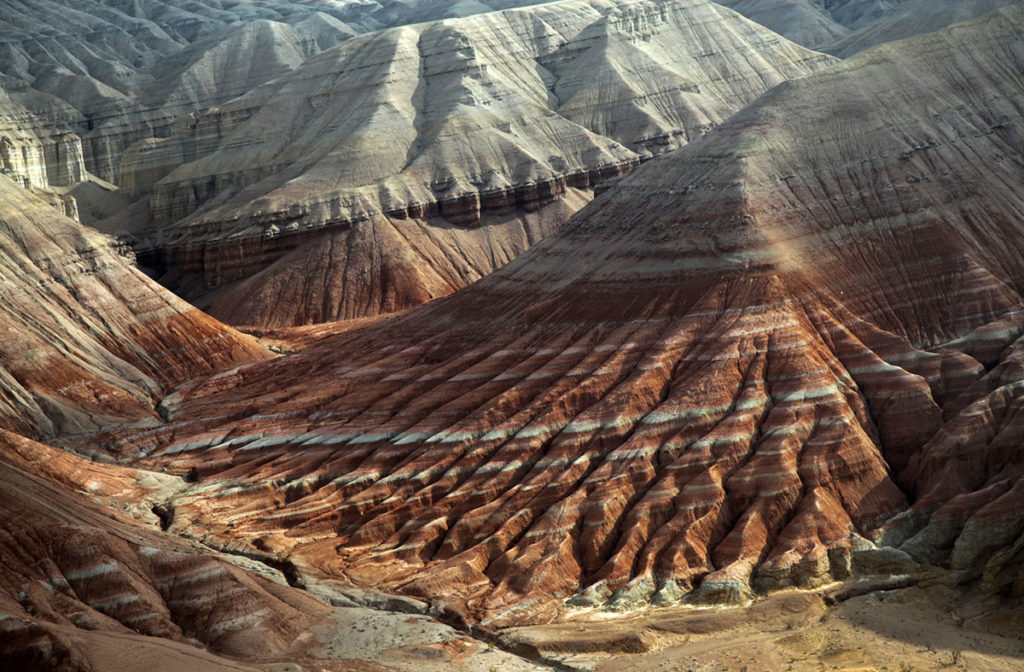
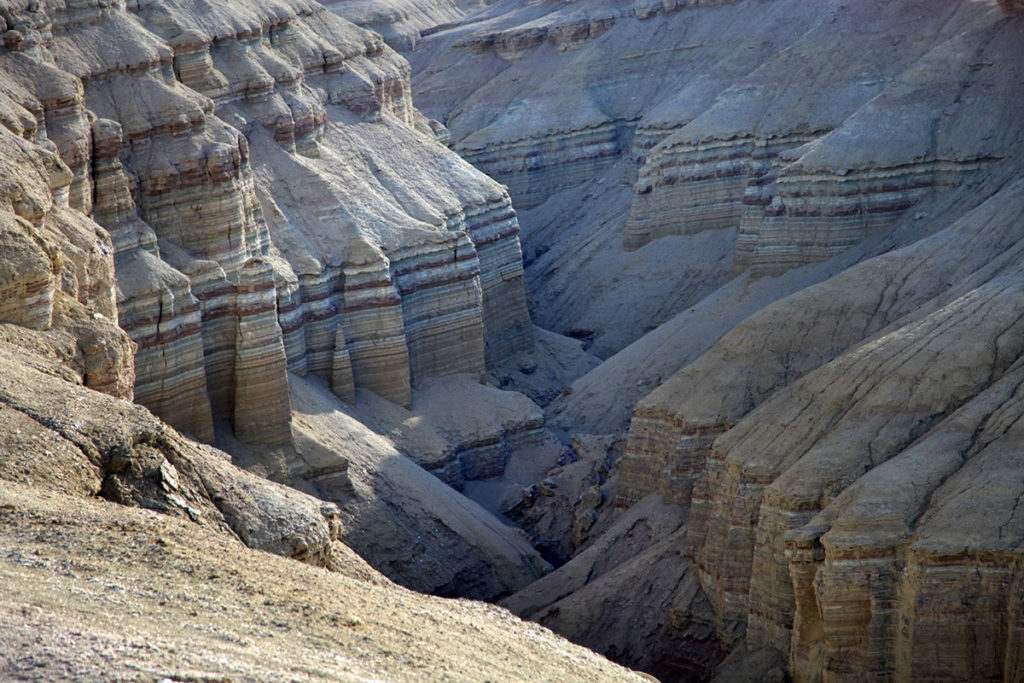
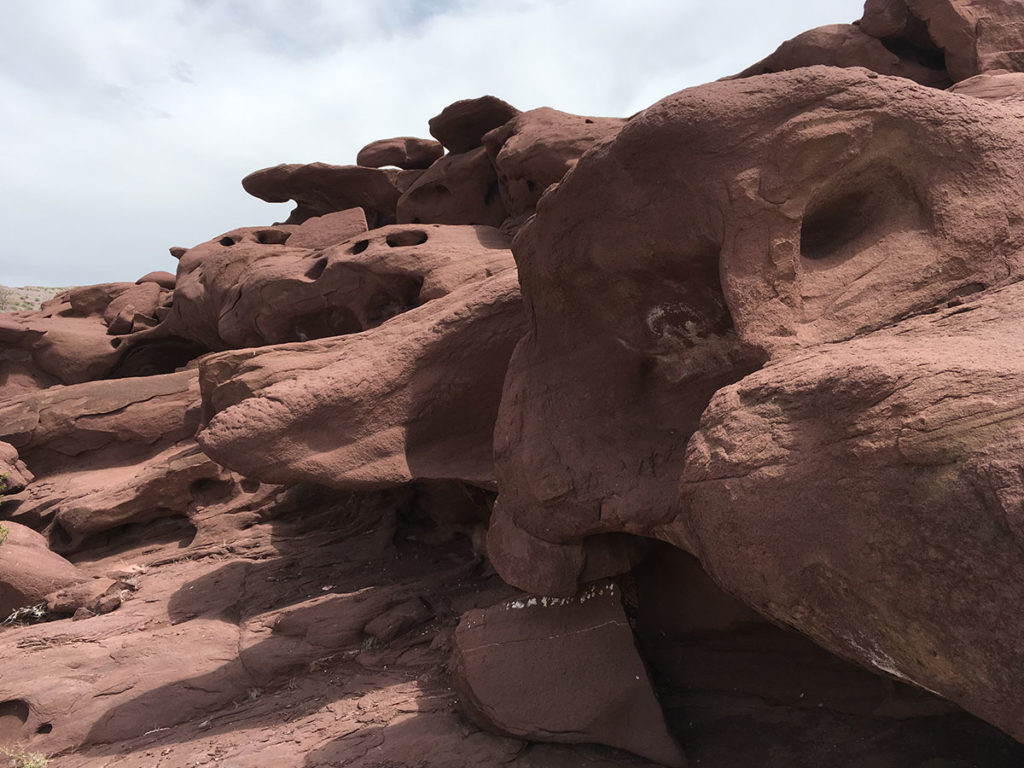
Firstly we usually visit very ancient ruined Katutau (Harsh Mountains). In Permian (approximately 240 million years ago) there were two big acting volcanos. The mountains are formed by lava and some associated volcanic rocks. In the mountain area, there are some inputs of the radiating dikes (a dike is earth split filled with magma. The split is formed by the earth’s movements like earthquakes or volcano eruptions). Some dikes are 8 kilometers long. In the northern part of the Katutau and Aktau, there are some sedimentary bedrocks of the ancient ocean Tethys. Impacted by the above-mentioned natural factors the rocks formed some spectacular shapes and landscapes.
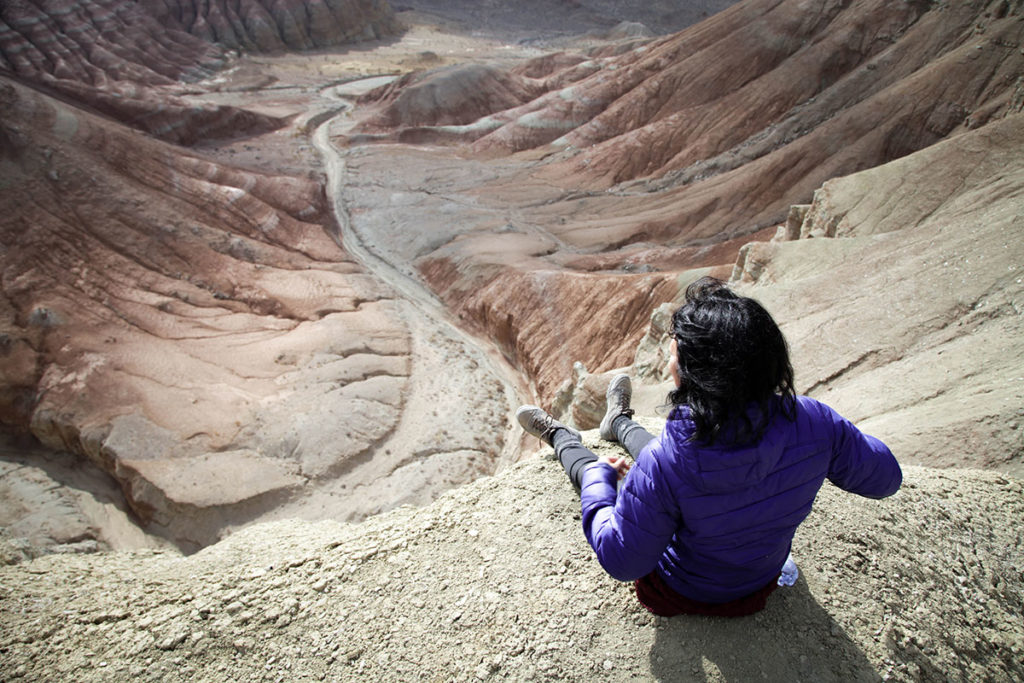
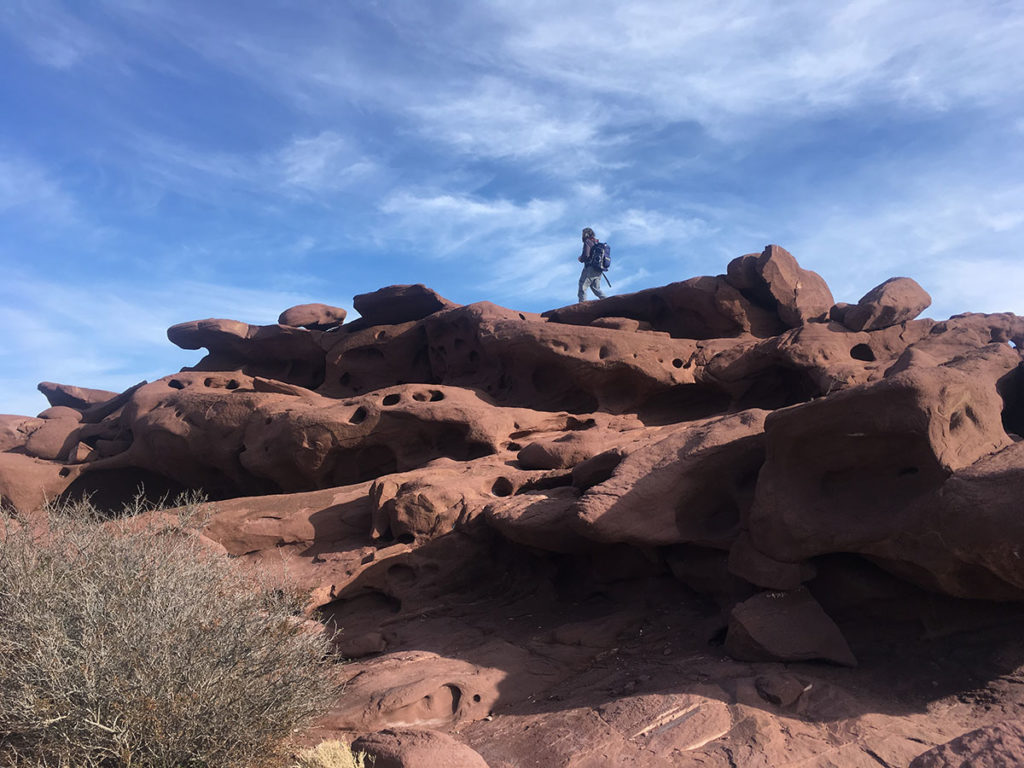
Today its unique shapes are well preserved and remain the same. These shapes include holes of all forms and sizes, grooves, cracks, gyrus, which sometimes resemble shelves, sometimes cups, or royal throne, just let your imagination guide you. These lifeless, ragged, white, pink, green, and red slopes look like an alien landscape. Event animals rarely come here. The environment looks like that of the Mexican savannah or North America’s canyons.
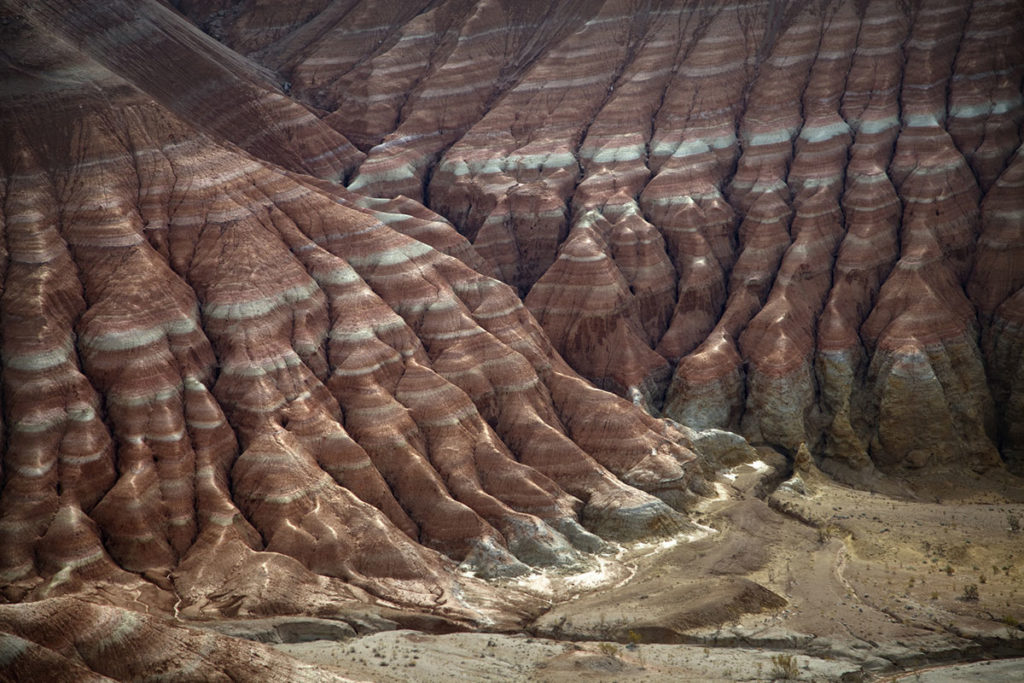
After Katutau we drive to see untouched, completely uninhabited Ak-tau (White Mountains) with ancient marine deposits from the former Tethys Ocean which are like a museum of the earth’s distant past. Fantastically-shaped natural sculptures rise from the bottom of an ancient sea in all the colors of the rainbow, from the pale blue “Lunar landscape” to the “red mountains”. These chalky mountains are 30 km long, 1.5-2 km deep – and 400 million years old. 56 species of the early Miocene flora were found here: pine tree, fir, birch, alder, oak, nut, chestnut, linden, hackberry, pistachio, cilantro, and many others. The remains of the ancient animals are preserved perfectly in the lake deposits of the Paleogene-Neogene (crocodile, tortoise, the giant rhinoceros, and some primitive predators) aged 25-30 million years as estimated. There is a rich variety of wildlife here, with large numbers of black-tailed gazelles, steppe antelope, mountain goats and sheep, wolves, and foxes.
After such an active two days you deserved the right to get good rest in the city or maybe continue the trip on our 4 or 5-day tours?
Tours to Altyn Emel National park
2-Day Tour To Altyn Emel National Park
Pack more memories into two days than most people get in two weeks! Travel by air-conditioned vehicle with an expert guide and learn the history and geology of each site. See the unique Singing Dunes, stunning Ak-tau & Katutau mountains, and immerse yourself in the rich flora & fauna of Altyn Emel. This is an unforgettable two-day adventure.
4-Day Active Tour
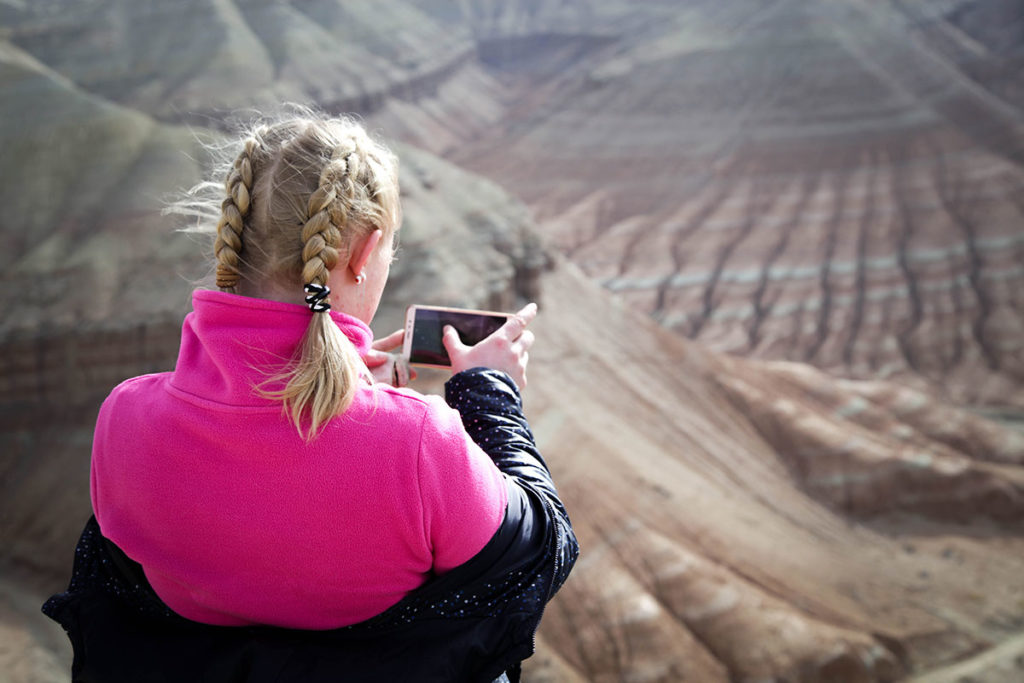
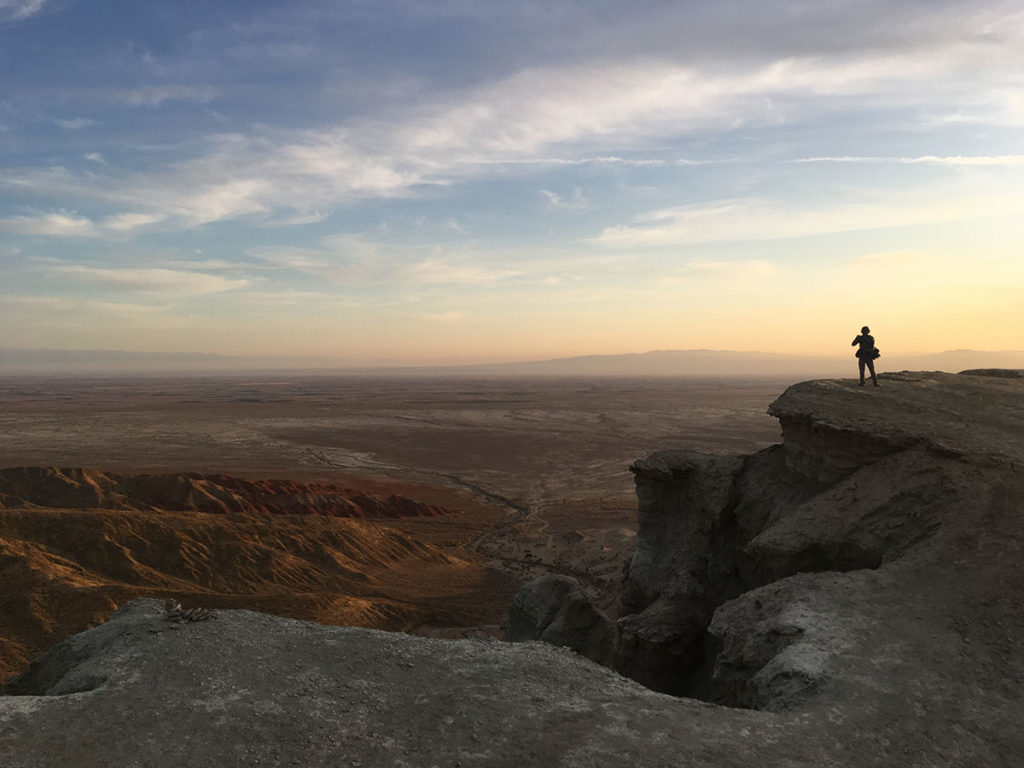
It is fair to call this area one of the best-protected nature reserves, since its topography and the absence of any infrastructure condemn visitors to travel hundreds of kilometers by jeep, fortunately, only very few visitors can endure. This place is Ustyurt plateau, 200,000 square kilometers (77,000 square miles) of clay and stony desert located on the territories of Western Kazakhstan & Uzbekistan. It is one of the largest geomorphological elements of Earth’s surface, which is like the Great Barrier Reef is clearly visible from space.
5-Day Active Tour
This is our offer to those travelers who prefer to spend more time in each place, enjoy the destination with no rush and have some free time at the end of the day. No doubt this is the best way to travel and we strongly advise you to choose this itinerary. On our 5 day tours, you will discover endless semi-desserts of Altyn Emel, stunning Charyn canyon, breath-taking Kolsai mountain lakes, and mysterious sunken forests in Kaindy lake. Join us for a full unforgettable Zhetisu experience!